Dull Patches Persist Despite Terrazzo Cleaning
Last Updated on October 7, 2026 by David
Unsure Which Cleaner Is Safe for Your Terrazzo Floor
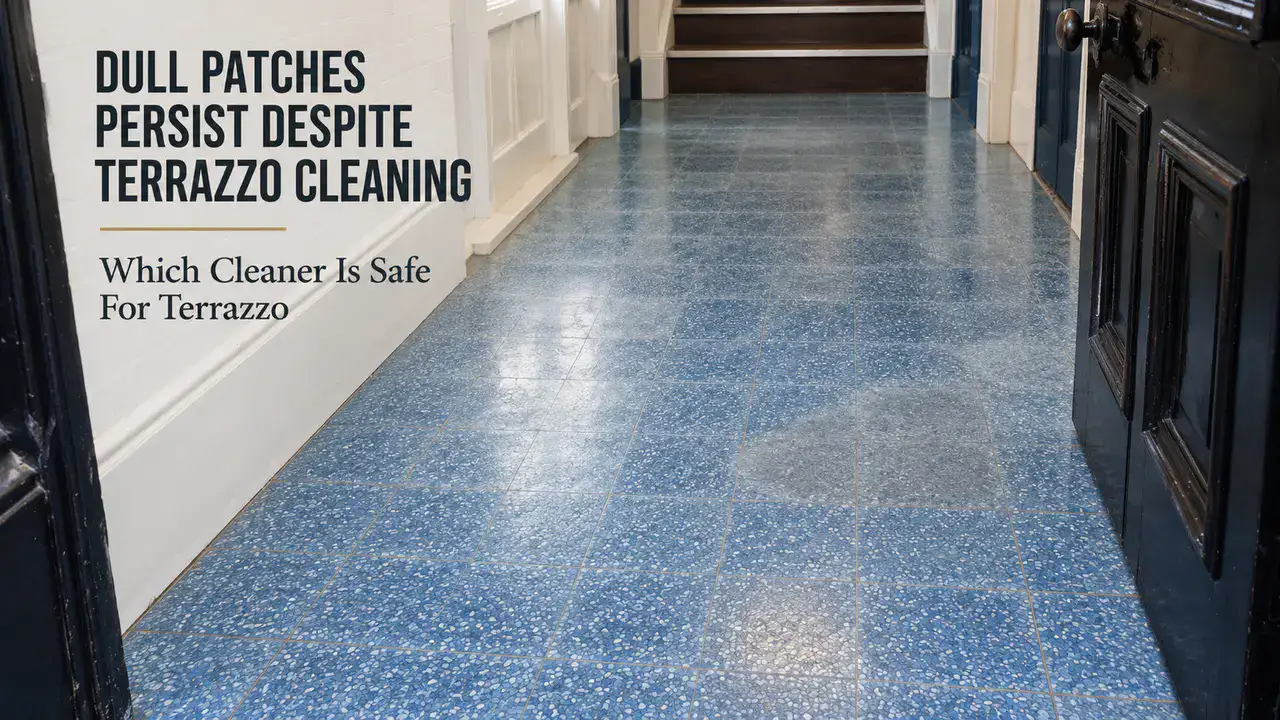
A terrazzo floor that appears dusty, streaky or darker than expected can make it difficult to tell whether the cleaner, the method or the floor itself is responsible. Comparing it with a cleaner section under the same lighting often helps separate ordinary surface soil from dullness that remains after mopping.
Loose soil will usually improve noticeably after careful cleaning, especially around entrances, kitchens and hallways where grit is brought in on footwear. If the floor becomes visibly clearer without pale patches developing, it is generally an ordinary maintenance issue rather than a reason to reach for a stronger chemical.
Persistent dullness raises a different question. When it remains after surface residue has gone, the problem may sit beyond ordinary soil, so the floor’s condition needs assessing rather than simply selecting a more aggressive product.
Stains need separate consideration. A mark around a plant pot, from a kitchen spill or from historic adhesive may remain after normal washing, and dark traffic lanes can run through a hallway whilst quieter edges retain more colour. A cleaner selected purely for heavy soil may therefore leave the underlying appearance unchanged.
Floor format also affects the decision. A continuous poured slab, common in pre-1950 UK properties, behaves differently from terrazzo tiles widely introduced from the 1960s onwards; individual tiles can show movement, uneven edges or hollow areas that require assessment rather than another product.
Cracking, loose edges, sandy patches and areas that sound hollow when lightly tapped are visible signs of deterioration. They can indicate loss of adhesion or a weakened matrix beneath the visible soil, whilst differences in tile height may create a practical trip concern. Pause product selection until the floor’s condition is understood.

Stains and Dull Patches Remain After Cleaning
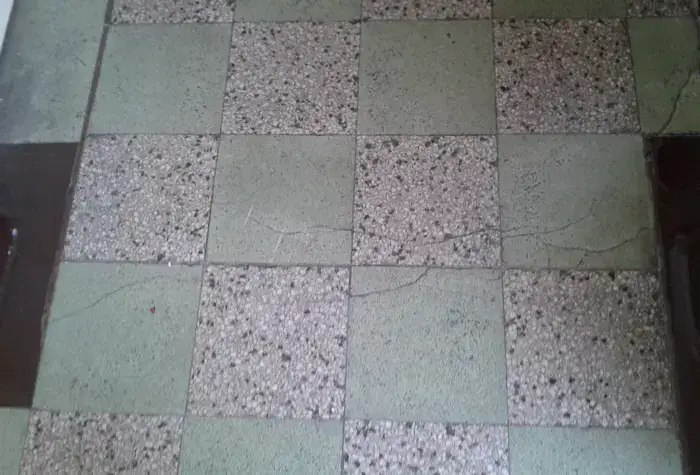
Persistent dull patches and dark traffic lanes may still show under low-angle light after loose soil and residue have been removed. Removable soil and residue will generally clear from a comparable undisturbed area, whereas a weakened cement matrix continues to appear grey, pale or uneven.
Acid etching occurs when acidic chemistry dissolves the cement surface and the calcium-carbonate decorative chips. The resulting mark looks dull and roughened, and washing will not remove it; the changed surface needs mechanical resurfacing rather than a stronger cleaner.
Binder weakening is cement deterioration that increases porosity, allowing soil to settle beneath the cleanable surface. Dark lanes, a chalky feel and recurring discolouration point to progressive damage, so professional assessment may call for surface renewal instead of repeated chemical extraction.
Lippage refers to height differences between adjacent terrazzo tiles. These uneven edges catch the light, hold dirt and may feel unsafe underfoot; grinding and flattening are the pre-honing correction, not a product choice.
Wear can reduce clarity without leaving a removable deposit. A suitable cleaner may still improve the floor substantially by lifting contamination, but it cannot replace lost surface material, remove scratches or level tile variation. Repeated stronger applications can make the problem worse.
Some Cleaning Mistakes Cause Damage You Cannot Undo
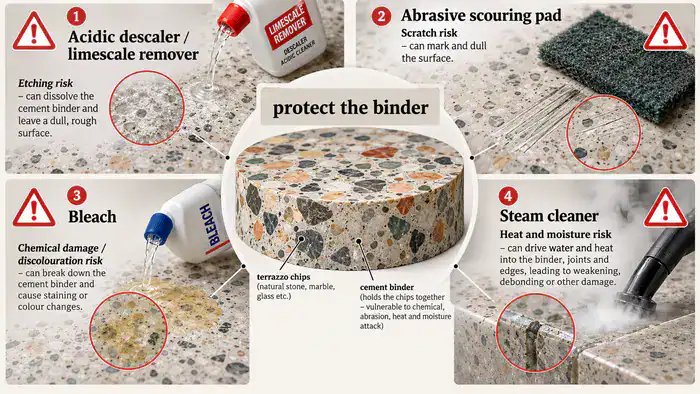
Using a harsh product on terrazzo can turn a straightforward cleaning job into permanent surface damage. Check the bottle label and look for soft or chalky areas before proceeding. Acidic products cause immediate chemical dissolution, whilst bleach, steam and abrasive tools introduce separate risks to the cement matrix and decorative chips.
Acid etching is immediate and permanent on terrazzo.
Repeated use of strong alkaline cleaners causes progressive cement deterioration by attacking the calcium-silicate structure, particularly where poor rinsing leaves alkaline chemistry behind. Where the surface feels friable or chalky, a specialist can use binder integrity testing to distinguish lower-risk surface soil from a condition requiring referral rather than further scrubbing.
Chemical poultice treatment uses an absorbent medium, such as kaolin or diatomaceous earth, to support solvent extraction, capillary draw and oil stain removal. But plastic-wrap dwell and evaporation need controlled assessment, not casual experimentation. Phenolic discolouration from a phenolic disinfectant or cresol can produce yellowing or dark staining through chemical attack on the cement binder, whilst chemical crystallisation involves a fluorosilicate thermo-chemical reaction that creates a micro-crystalline layer through friction heat. Neither is part of routine product selection.

Readers who want to explore wider warning signs can compare these risks with common hidden threats to terrazzo floors. The practical approach is straightforward: clean cautiously where surface soil is loose, but refer the floor where the matrix feels weak or its appearance remains altered.
A Cleaner Made for Cement-Based Terrazzo
Routine care
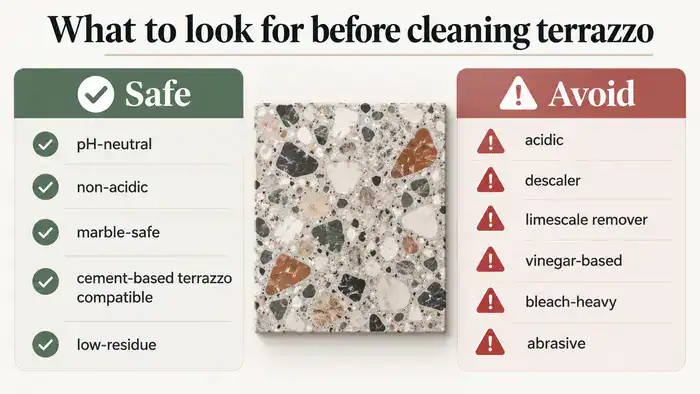
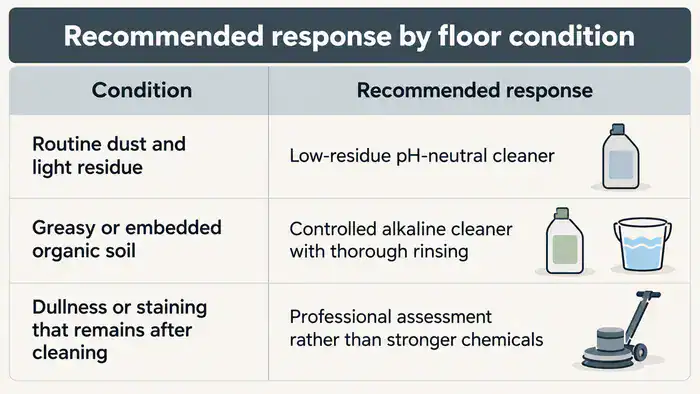
For a floor carrying light dust or everyday kitchen residue, use a low-residue pH-neutral cleaner rather than a stronger formula. An acid-free, marble-safe product maintains pH balance, leaves minimal film and supports everyday cleaning without etching risk. Remove dry grit with a soft microfibre pad before damp mopping.
Heavier embedded soil
Greasy contamination that remains after routine care may justify a controlled alkaline cleaner, as professional-grade alkaline chemistry supports organic soil removal and contamination extraction. Application must be controlled, use limited and rinsing thorough, because residual alkalinity can accelerate binder weakness. A rotary scrubber or floor buffer is no substitute for careful slurry management.
When product choice has reached its limit
Dullness, dark traffic lanes or staining that persists after suitable cleaning shows that a cleaner has reached its practical boundary. Professional assessment may then be needed, with mechanical grinding using a planetary grinding machine forming one possible restoration pathway.

Mechanical resurfacing removes a thin worn layer rather than concealing it with polish or sealant. With appropriate grinding, honing and, where suitable, polishing, the floor can look significantly better. A correctly sealed surface will also be easier to clean and maintain than one that is worn or incorrectly treated.
Terrazzo Compatibility on the Product Label
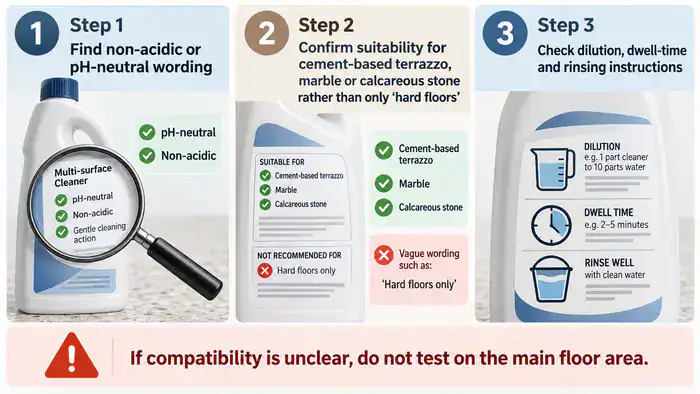
When holding the bottle up to the light, look for clear terrazzo-compatible wording: non-acidic chemistry, pH-neutral routine use and low residue. The label should confirm suitability for cement-based terrazzo, rather than relying on a broad claim that it works on all hard floors.
Pro Tip: We recommend these products for daily Terrazzo maintenance cleaning.

Fila Pro Floor Cleaner
|

LTP MPG Sealer H20
|

Vileda H2PrO Spin Mop System
|
A suitable cleaner supports routine maintenance without leaving detergent film, and it should not claim to restore scratches, etching or a softened matrix. Waterproof claims also need careful reading: a cleaner cannot create a moisture barrier, whilst a sealer reduces absorption rather than preventing acid damage or scratching.
Good ongoing maintenance starts with removing grit before wet mopping. It limits stain penetration and helps retain gloss. Correct pH-neutral cleaning, prompt spill removal and sealer reapplication at the appropriate interval offer the strongest protection for the floor’s remaining life. Broader care, polishing and restoration decisions sit within the wider terrazzo flooring guidance.

David Allen — Abbey Floor Care
David Allen has more than 30 years of experience helping UK homeowners evaluate terrazzo cleaning products and restoration boundaries through Abbey Floor Care. His buyer-led guidance focuses on matching pH-neutral and controlled deep-cleaning choices to cement-based terrazzo, whilst recognising when dullness, staining or binder wear requires specialist assessment.
Recent Posts:
We work throughout the country, just some of our work counties:
Copyright © 2026 Abbey Floor Care. Tile And Natural Stone Cleaning Consultants FAQ - Privacy Policy - Terms And Conditions
Abbey Floor Care is a participant in the Amazon Services LLC Associates Programme, an affiliate advertising programme designed to provide a means for websites to earn advertising fees by linking to Amazon.co.uk. As an Amazon Associate, we earn from qualifying purchases.